Tach Time
Tach time is the engine time shown on the recording tachometer. The tach counts engine revolutions and converts them to hours at one calibration RPM, usually a cruise setting. Below that RPM, one tach hour takes longer than one clock hour.
Owners and maintenance shops use tach time for engine time since overhaul and for many inspection intervals. Some flying clubs also bill rental by tach.
Why tach time runs slower than Hobbs time
A training flight spends time at idle, in the run-up and in the pattern at low power. During that time the tach advances slowly, while the Hobbs meter runs at clock speed. Example readings from one aircraft:
| Flight | Hobbs | Tach |
|---|---|---|
| Cross-country at cruise power | 2.0 | 1.9 |
| Pattern work with touch-and-goes | 1.5 | 1.1 |
The gap depends on the flight profile, so no fixed ratio converts one meter into the other. Record both meters on every flight if you bill by one and maintain by the other.
Inspection intervals on tach time
In the US, an aircraft used for flight instruction for hire, or to carry people for hire, needs a 100-hour inspection (14 CFR 91.409(b)). Many operators count those hours on the tach. The limit can be exceeded by up to 10 hours to reach a place where the inspection can be done, and the extra hours count toward the next 100.
Oil changes often run on a double interval. Lycoming, for example, recommends an oil change every 50 hours or 4 months, whichever comes first, for engines with a full-flow filter.
Track inspections on the tach meter
Set a maintenance reminder on the tach meter, such as a 100-hour inspection every 100 hours. Give the oil change a meter schedule of 50 hours and a calendar schedule of 4 months. A reminder with two schedules is due at the one that comes first.
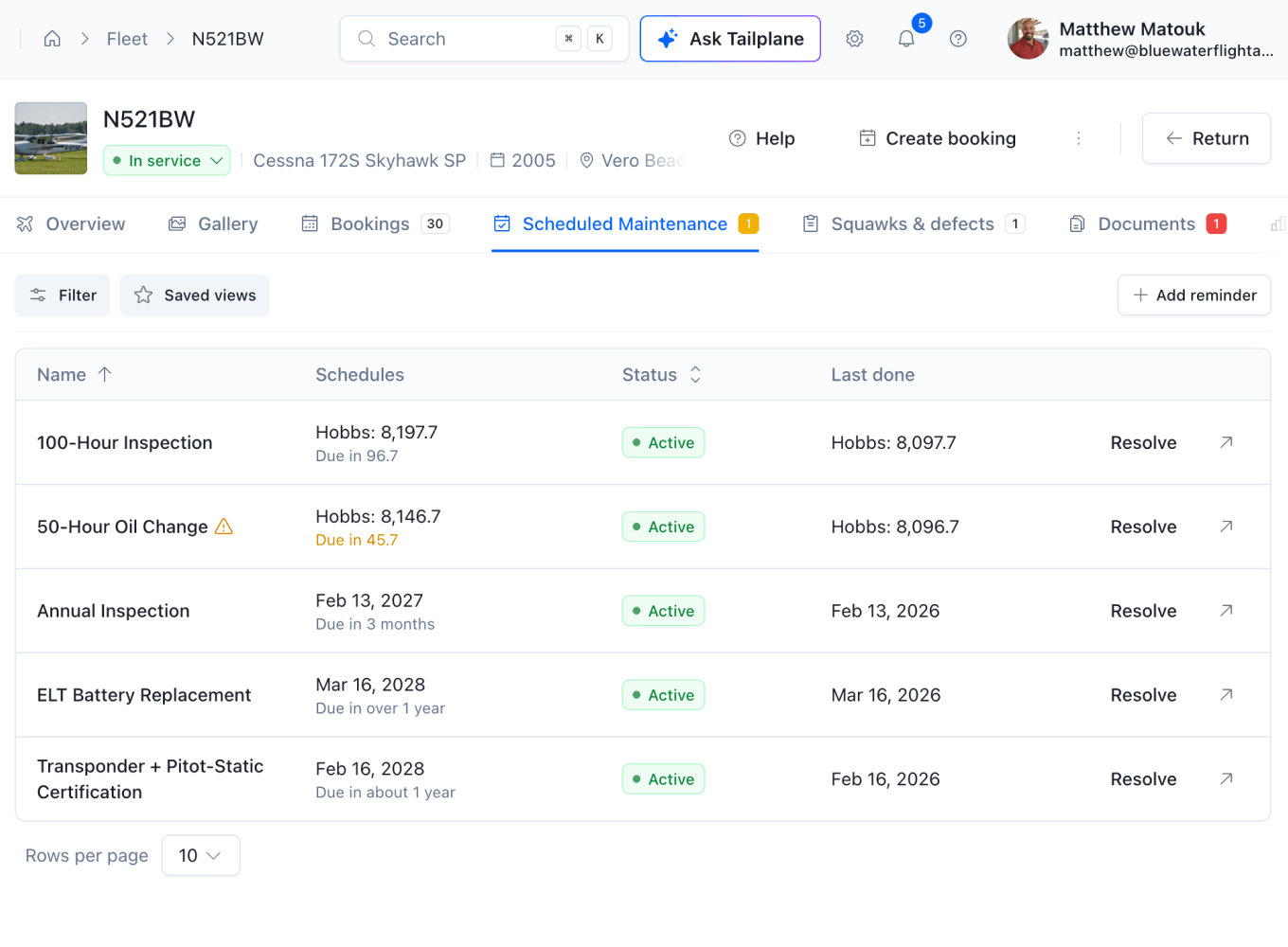
Each schedule shows the interval, the last time it was done, the next due value and the current meter reading. The tach reading comes from the in value that the instructor enters in the debrief, so the hours left are current after each flight.
Sign off the work with the tach value at which it was done. The value cannot be lower than the last sign-off or higher than the latest reading, and the next due value is the sign-off plus the interval. Record the work itself in the aircraft maintenance log. See fleet and maintenance tracking.