Risk Assessment
A risk assessment rates how likely a hazard is to cause harm and how bad the result would be. The rating decides what happens next: accept the risk, reduce it, or stop the operation.
Flight schools assess risk at two levels. Pilots assess each flight before they go. The school assesses hazards in its operation, such as a busy training airspace or a new aircraft type, as part of its safety management system.
Assess each flight with PAVE
The FAA's PAVE checklist covers four areas before a flight: the Pilot (health, currency, fatigue), the Aircraft (equipment, performance, fuel), the enVironment (weather, terrain, airspace) and External pressures (schedule, passengers, cost). Many schools turn it into a scored form, a flight risk assessment tool, with a score above which an instructor must approve the flight. Go through it in the preflight briefing.
Rate a hazard on the 5×5 matrix
ICAO Doc 9859 rates likelihood from 1 to 5 and severity from A (catastrophic) to E (negligible). Each cell of the matrix falls into one of three regions: intolerable, tolerable or acceptable.
A worked example:
- Hazard. Students fly solo at an airport where the afternoon wind often blows across the runway at more than 15 knots, the maximum demonstrated crosswind of a Cessna 172S.
- Initial rating. The likelihood of a runway excursion is remote (3), and its result is hazardous (B). The rating is 3B, tolerable.
- Controls. Set a solo crosswind limit of 10 knots, and schedule student solos in the morning.
- Residual rating. The likelihood drops to improbable (2). The severity stays at B, because the controls do not change the result of an excursion. 2B is still tolerable, so someone with authority must accept the residual risk and write down why.
Rate the residual risk after the controls are in place. Lower the severity only when a control changes how bad the result would be.
Rate risk and accept residual risk
Rate the risk of each safety report and each hazard on the ICAO 5×5 matrix, with a rationale. Likelihood runs from Extremely improbable (1) to Frequent (5), and severity from Negligible (E) to Catastrophic (A). Every rating is kept, so a new rating does not change the earlier ones.
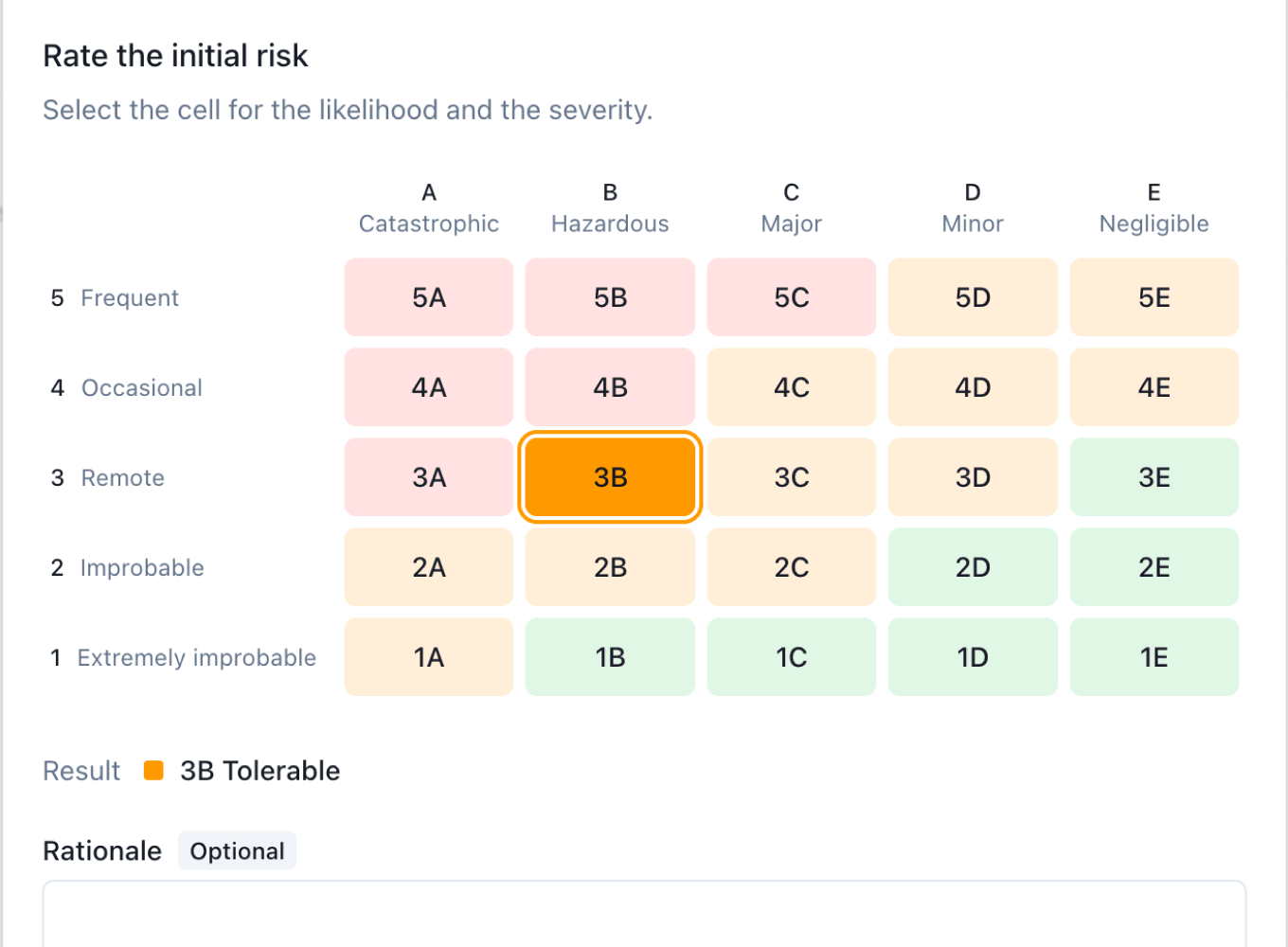
Add an initial rating to each hazard in the hazard register, then residual ratings as corrective actions take effect. A tolerable residual risk needs formal acceptance, with a rationale, by staff with permission to accept risk. An acceptable risk needs no acceptance, and an intolerable risk cannot be accepted. See safety management.